A second retail location needs a point-of-sale (POS) plan that fits both the checkout and the business’s finances. Start by defining the equipment, the payment commitment and the responsibilities that come with it. Then assess whether an outright purchase or a lease fits those needs.
A useful review of small business POS lease options goes beyond the monthly equipment payment. It separates equipment from software, payment processing and service, and makes the full agreement understandable before signing. An independent sales organization (ISO) or equipment partner can use the same approach to help a merchant evaluate a proposed setup.
Key Takeaways
- Define the same equipment configuration before assessing purchase and lease arrangements.
- Read the complete equipment payment schedule, term and end-of-term provisions together.
- Identify software, processing and service charges separately, using the actual provider’s information.
- Check responsibilities for warranty and service; equipment financing does not establish coverage.
- Use the written agreement for renewal and early-ending provisions, rather than a generic deadline or penalty example.
Separate the POS cost categories
Begin with the proposed checkout configuration. List the POS devices, card terminals and peripherals included, along with the location and purpose of each device. Check the configuration with the equipment provider instead of assuming a familiar product name describes the entire setup.
Then identify the separate relationships needed to operate it. The equipment arrangement answers one set of questions; software access, transaction processing and service answer others. A single presentation can discuss these together, but the merchant still needs to understand who supplies each part and which written terms apply.
| Category | What to establish | Where to verify it |
|---|---|---|
| Equipment | Included devices, payment obligations and equipment outcome | Equipment description and applicable purchase or lease documents |
| Software | Licensed functions, users or locations, and applicable charges | Software provider’s proposal and agreement |
| Payment processing | Provider, transaction pricing and other stated processing charges | Processing proposal and agreement |
| Installation and training | Who performs the work and what is included | ISO or service provider’s written scope |
| Warranty and service | Applicable coverage, exclusions and responsible provider | Manufacturer and service documents |
Record each charge once under the relationship that creates it. If a provider bundles services with equipment, clarify the included scope before adding a separate service allowance. If a price or responsibility is missing, keep it as an open question rather than filling the gap with an industry average.
Executech Lease Group (ELG) does not provide equipment warranties, maintenance, repairs or replacements. Any manufacturer warranty must be checked separately. Do not assume that the length of a lease establishes the length of warranty coverage.
Assess ownership and payment commitments
For an outright purchase, review the seller’s documented payment and ownership terms. For a lease, review the payment schedule, contract term and end-of-term provisions together. Those are different arrangements, and neither can be judged from a single payment amount.
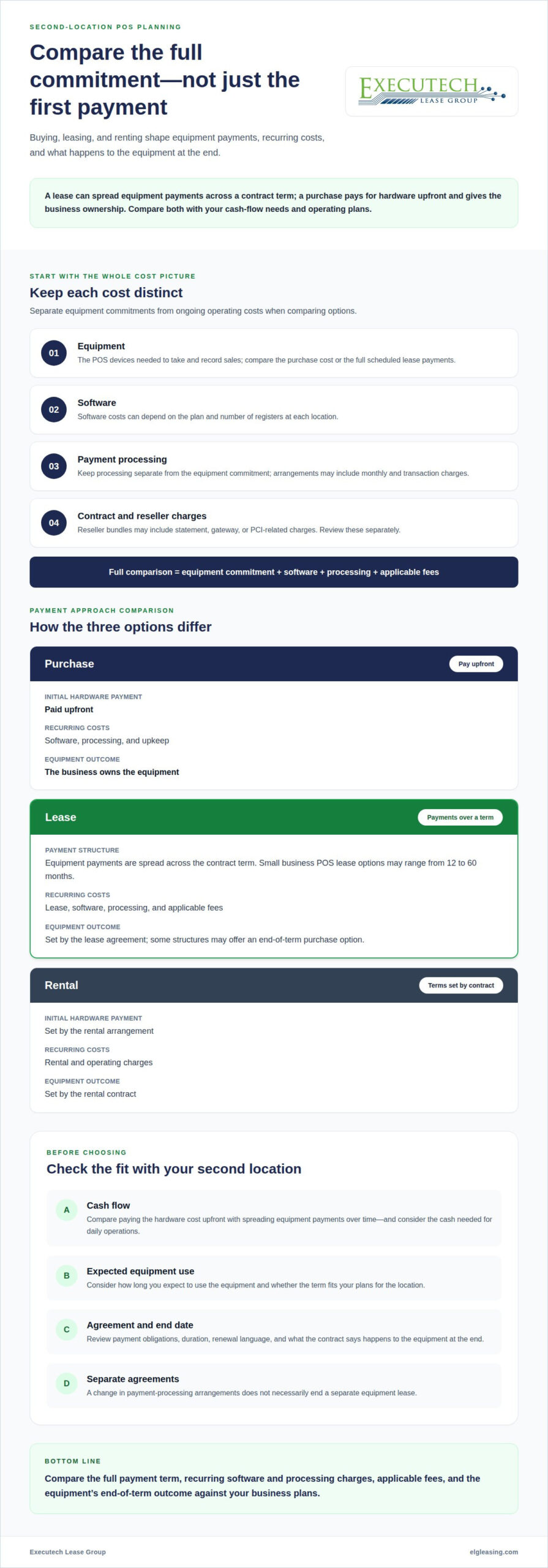
Consider how the equipment commitment fits the second location’s operating plan. Assess the timing of equipment payments alongside inventory, staffing and other planned expenses. Leasing spreads equipment payments over a contract term, but those recurring obligations still need room in the budget. This does not establish that leasing costs less or improves cash flow for every business.
Ownership preference is a separate question. Decide how important eventual equipment ownership is to the business, then check whether the proposed arrangement supports that objective. ELG’s fair-market-value (FMV) and lease-to-own structures have different end-of-term provisions. Use the particular written agreement to identify the applicable structure and obligations.
Also confirm that the proposed devices work with the intended software and processing arrangement. Financing does not prove compatibility, software licensing, processor portability or support coverage. Obtain those answers from the provider responsible for the relevant equipment or service.
Read the payment structure accurately
A scheduled equipment lease payment is a contract commitment. Describing it as simply “pay as you go” can obscure that distinction. Read the payment amount, frequency, number of payments and other stated obligations as one complete schedule.
Keep that schedule separate from the operating budget for software and processing. When reviewing alternative arrangements, use the same equipment scope and the same planning assumptions. If the setups differ, identify the difference before drawing a conclusion about affordability.
Do not infer charges from a general description of POS leasing. Use the amounts and obligations in the documents provided for the transaction. Likewise, do not infer tax or accounting treatment from the words “lease,” “FMV” or “lease-to-own.” Bring those questions to the business’s CPA.
A clear decision record identifies the equipment commitment, other provider charges, ownership objective and unresolved questions. It does not need an invented savings figure or a promise that one approach is universally better.
The accompanying infographic compares general equipment arrangements. Its rental comparison is general context, not an ELG rental offer. Confirm the proposed lease term for the particular transaction; a displayed term range does not promise every term for every applicant.
A second-location planning checklist
Consider an illustrative planning situation: a retailer is preparing a second location and needs a counter checkout and card terminal. This is a planning example, not a customer story, equipment recommendation or price quote.
First, have the equipment provider confirm the configuration for the new location. The existing store is a starting point for discussion, not proof that the same devices, licenses or service arrangements apply at another site.
Next, organize the information needed for a decision:
- Equipment scope: Which devices are included, and what work will each perform?
- Payment commitment: What does the proposed purchase or lease arrangement require, and when?
- Operating services: Which software, processing, installation and training arrangements apply to this location?
- Responsibilities: Who answers equipment, software, processing and service questions?
- End-of-term provisions: What does the lease state about the equipment and any steps required when the term ends?
Keep an explicit list of information still needed. An omitted software charge is not a zero charge; an unstated warranty is not confirmed coverage. Resolve those items with the responsible provider before treating the comparison as complete.
For an ISO or agent, this checklist also helps keep the explanation consistent. The merchant can see which questions concern the lease and which belong with the software, processor or service provider. That clarity is useful whether the merchant ultimately chooses a purchase or a lease.
Review the actual contract provisions
Read the proposed agreement’s term, payment schedule, renewal language and end-of-term provisions before signing. Ask the relevant contracting party to explain anything unclear. A general article cannot establish the terms of an individual agreement.
For renewal or notice provisions, identify the actual wording, applicable dates and any specified delivery method in the agreement. Do not substitute a generic notice period. If the wording is unclear or the consequences are significant, discuss it with an attorney before relying on an interpretation.
Use the same approach to questions about ending an agreement early. Request clarification based on the specific contract rather than estimating a penalty from an example involving a different merchant or lease. Do not assume that a location closure or a change in processing arrangements resolves a separate equipment obligation.
Keep the documents and written clarifications together so the business can revisit them when planning for the end of the term. This review establishes which questions need answers; it does not promise a cancellation right, renewal outcome or release from payment.
Where ELG fits
ELG is an equipment lease brokerage serving the merchant-services and payments-technology ecosystem. ELG leases POS and card terminal equipment, including Clover devices. Mentioning a device does not imply a manufacturer or processor partnership.
ELG does not process payments, supply a merchant account or set transaction pricing. Its equipment leasing role is separate from software and service relationships. ELG does not currently offer hardware subscription programs or SaaS financing.
Installation and training can be included when the ISO bundles those services with the equipment. The ISO supplies those services; ELG does not perform them. Identify the actual scope and provider in the transaction documents.
Prepare a clear equipment conversation
The practical next step is to make the proposed arrangement understandable: defined equipment, a complete payment schedule, clearly assigned responsibilities and confirmed end-of-term provisions. Keep open questions visible until the appropriate provider answers them.
ISOs, agents and equipment partners can contact ELG to discuss developing equipment leasing business together.
Frequently asked questions
Does ELG provide an equipment warranty?
No. ELG does not provide warranties, maintenance, repairs or replacements. Any manufacturer warranty must be checked separately.
Does ELG process payments?
No. The equipment lease and the payment-processing relationship are separate.
This article reflects the author’s opinion for general information only and isn’t tax, legal, or accounting advice. Consult your CPA or attorney about your specific situation.

Article by
Robert Ensminger
Robert Ensminger is the founder and CEO of Executech Lease Group (ELG Leasing), which specializes in equipment leasing and financing solutions for the merchant-services, payments, POS, and FinTech industries. Robert helps ISOs, payment processors, POS providers, and software companies build practical equipment leasing programs. He founded ELG in 2010. His work focuses on responsive service, transparent program structures, SaaS-monetization programs, and helping ELG’s partners close more business while creating sustainable revenue.